
NFP Principle 5 - Performance & Accountability
Accountability is not simply a compliance requirement

Whether an organisation delivers food, beverage and entertainment (like clubs), community services, advocates for social change, or provides specialised support to vulnerable groups, stakeholders expect transparency, responsible stewardship, and demonstrable impact. The Not‑for‑Profit Governance Principles – Third Edition (April 2024) emphasise that accountability is not simply a compliance requirement — it is a strategic tool that enables NFPs to fulfil their purpose with integrity and confidence.
We are going to explore the key elements of performance measurement, financial oversight, impact evaluation, and transparency, drawing on the guidance provided in Principle 5: Performance and Accountability.
Why Performance Measurement Matters
For an NFP to demonstrate that its activities contribute meaningfully to its mission, it must define and evaluate performance against clear measures. As the document states, “Boards should select a mix of financial and non-financial performance measures to help present a complete picture of the NFP’s performance.” These measures should align with the organisation’s purpose, vision, and strategy, ensuring that performance monitoring is not just a numbers exercise but a reflection of mission delivery.
Performance measurement serves several critical functions:
X It helps boards understand whether programs and services are achieving intended outcomes.
X It supports strategic decision‑making by highlighting what is working and what needs refinement.
X It provides evidence to funders, regulators, and donors that resources are being used effectively.
X It strengthens internal accountability by setting clear expectations for management and staff.
Financial Performance: The Foundation of Sustainability
Financial sustainability is essential for any NFP. Without a reliable flow of funds, even the most impactful mission cannot be delivered effectively. Directors have a joint responsibility to understand the organisation’s finances (Financial literacy was a cornerstone of the Centro Case in 2009) and this duty cannot be outsourced to treasurers or external accountants. Regular financial reporting and active oversight ensure that the board can identify risks early and make informed decisions. Directors’ fiduciary duty is to ensure ongoing solvency – the ability to pay debts as and when they fall due.
Key Financial Indicators
Table 4 outlines common financial indicators used across the sector:
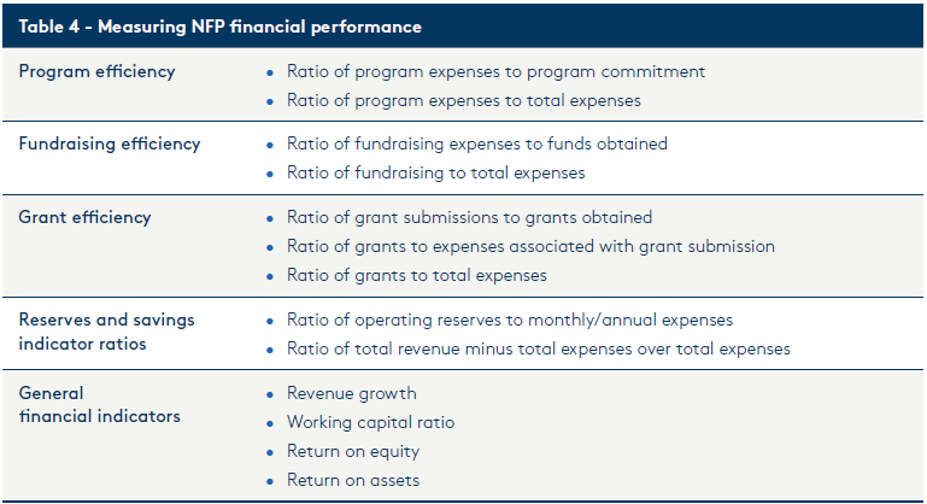
Together, these measures help boards evaluate sustainability, efficiency, and financial resilience.
Financial Budgeting, Reporting & Solvency Oversight
Effective board reporting is central to understanding the organisation’s financial position. Core financial statements — balance sheet, profit and loss, and cash flow — should be presented regularly e.g. at every board meeting depending on meeting frequency, or provided on a more frequent basis (preferably monthly) if there are only, say four board meeting per year. It is also an idea for boards to periodically meet with auditors, without management present, to gain independent insights.
Solvency is a critical area of responsibility. Whilst some NFPs, like registered clubs tend to have reliable cashflow from their provision of services to the community, many NFPs rely on temporary or non‑guaranteed funding sources (like grant funds or the odd donation), making cash flow management essential. Directors must ensure the organisation does not operate while insolvent, a requirement reinforced by ACNC Governance Standard 5.
Monitoring solvency includes:
X Reviewing cash flow forecasts
X Assessing working capital ratios
X Understanding funding dependencies
X Ensuring adequate reserves
Directors of charities that are companies limited by guarantee may also access the Corporations Act’s safe harbour provisions should they need to pursue restructuring or turnaround strategies. Best not to drop the ball on finances and go there.
Measuring Effectiveness and Impact
Financial performance tells only part of the story. NFPs exist to create positive change — whether improving mental health, supporting disadvantaged communities, or protecting the environment. Increasingly, funders and regulators expect organisations to demonstrate the effectiveness and impact of their programs.
Boards should ensure that:
X Programs have clear objectives and measurable outcomes
X Data is collected consistently and meaningfully
X Impact is assessed at organisational, program, and initiative levels
X Results are communicated transparently to stakeholders
This may include client surveys, outcome tracking, case studies, or external evaluations. Impact measurement not only strengthens accountability but also builds credibility with funders and the broader community. Regular reporting of a charity’s impact – benefit to the community or group they serve – will help secure recurrent funding for the organisation.
Good Governance
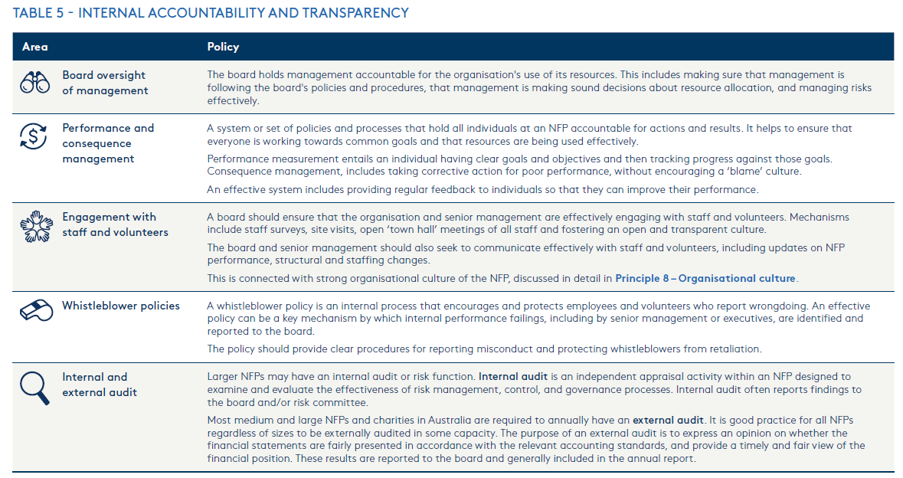
Internal accountability mechanisms ensure that individuals within the organisation are working toward shared goals and adhering to policies and procedures. Table 5 outlines several key areas:
External Accountability & Transparency
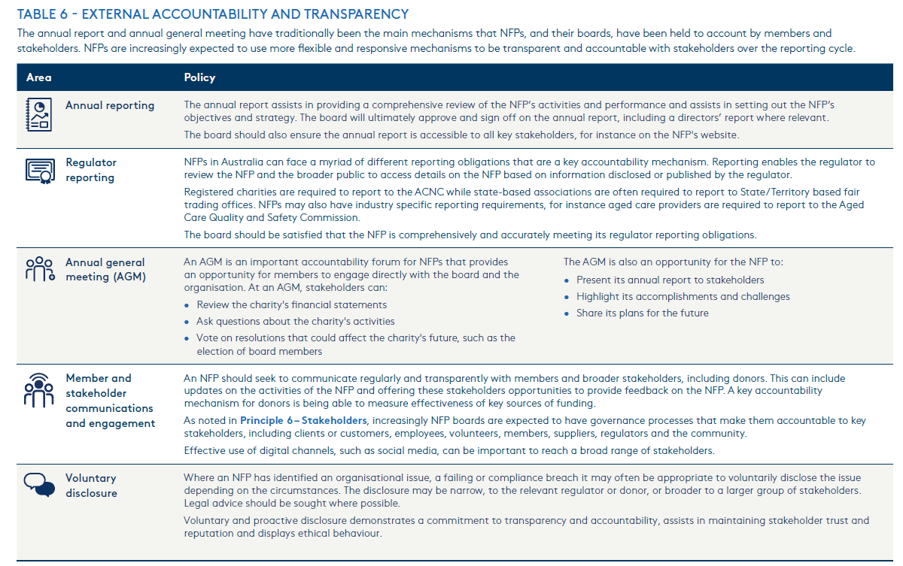
NFPs are held to high standards due to their public funding and community‑focused missions. Table 6 outlines key external accountability mechanisms:
A unique factor for many charitable NFPs is the percentage of funds raised that are actually applied to the programs they run, or the intended recipients. Some organisations have fallen foul of excess expenditure on Administration, which chews into the amount that can actually be applied to the charity’s purpose. There is no hard number here, but if possible, limiting admin expenses to fifteen (15) percent or less of total revenue means eighty-five (85) percent is applied to the program the charity exists to deliver.
Directors also need to be conscious of the resources other than financial, required to operate –
X Human Resources – the staff required to deliver your programs and services
X Physical Resources – the building, plant and equipment required
X Intellectual Resources – the programs and knowledge that is the intellectual property of your organisation and team
Oversight of these other resources is also another critical performance measure that directors need to report to stakeholders.
A critical element referred to in Table 6 is Reporting. Depending on the legislation governing your NFP, you may need to report on a regular basis to your stakeholders. For example, registered clubs in NSW must provide a quarterly report to their members – Profit and Loss, Balance Sheet and Trade Accounts – in addition to the requirement for an Annual Financial Report at the end of the financial year.
As a footnote, one of my personal aspects of performance and accountability relates to the Board room. Are all your directors engaged, contributing and adding value to the organisation? If they don’t read their board pack prior to the meeting, don’t contribute to discussion around the board table and don’t have a good grasp of the organisation’s position – financially and in delivering its impact – why are they on the board? Assessing the performance of the Board as a whole and directors individually can be a critical part of the performance equation, not just focussing on management and staff.
For more information on how to measure your NFP organisation’s performance and accountability, or assistance in conducting a Governance Audit, contact Ron Browne ron@extrapreneurservices.com.au 0414 633 423.