
NFP Governance Principle 1 - Purpose, Vision & Strategy
As an NFP, is your board focused on these principles?
Principle 1 - Purpose, Vision and Strategy
The Australian Institute of Company Directors (AICD) published the updated Not For Profit (NFP) Governance Principles in April 2024. As an NFP, is your board focused on these principles, or at the very least, are you using them as guidelines for your organisational governance?
A quick reminder that Not for Profit only means that profit/surplus revenue is NOT distributed to “shareholders” as dividends. Rather surpluses are reinvested in providing support to the community through the products, services and facilities that the NFP delivers to their community. Being an NFP does not mean you do not make a profit. You must be profitable to survive and support your community, just like any for profit business.
Principle 1 – Purpose
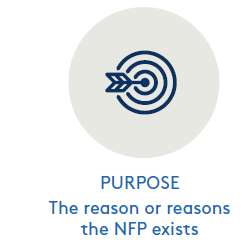
In order to ensure the sustainability of your organisation, it is the specific responsibility of the senior leadership team – i.e. the Board of Directors and the senior executive(s) – to define the organisation’s Purpose, Vision and Strategy, defining the direction the organisation will follow to fulfil its reason for being. Many NFPs have a single purpose – providing support for a specific form of disadvantage – or they may have two or three objects defined in their constitution – providing accommodation, health care services and education.
Many NFPs are also registered charities, who are able to raise funds from supporters with a Deductible Gift Recipient (DGR) Status, providing tax breaks to those who donate funds to them. Other NFPs can be registered with the Australian Charities and Not for Profits Commission (ACNC) and the organisation itself can be eligible for tax breaks, under a specific set of rules.
Tax status is not the key here, rather the purpose the organisation exists to fulfil and the organisation needs to be very clear what they are trying to achieve and provide to others. Chambers of Commerce are NFPs that provide networking and support opportunities to businesses in the community, with connection to other business owners and educational support on better business practices. Registered clubs are NFPs that often provide multiple benefits to their community including but not limited to sporting facilities and funding, food, drink and entertainment, accommodation, health facilities and retail offerings.
Once the Purpose is well established, as part of the strategic guidance of the leadership group, Vision, Mission and Values are usually defined and promoted for the organisation to share with the community.
Principle 1 – Vision
The Vision is a succinct statement of the organisation’s Purpose for people to learn and understand. The Mission is usually a supporting statement or paragraph which expands on how the Vision is going to be achieved.
Principle 1 – Strategy
The final, critical and often undervalued part is the Strategy that the organisation will execute to achieve its Purpose and Vision. The responsibility for developing the Strategy is with the Board of Directors with the assistance and input of the senior executive and his or her team of upper management executives (depending on the size of the organisation. Some argue that the senior executives should develop the Strategy and present it for ratification to the Board, however the key role and responsibility for Directors on any Board is the Strategic Direction of the organisation. The executive management and staff provide essential input through research, provision of data and operational expertise, to facilitate the Directors’ decision making process in creating a Strategic Plan.
Once the Strategic Plan/Strategy is approved by the Board, it is passed to the Executive Management and staff to execute in the operation of the organisation. During implementation, the Board must monitor the achievement of the Strategic Objectives on a regular basis, to ensure the organisation is operating true to purpose.
Strategic Oversight
AICD Principle 1 asks how the organisation’s Purpose, Vision and Strategy are communicated to the stakeholders, how often the Board reviews these and how the progress of achievement is reported to the Board?
To demonstrate effective due diligence in these endeavours by a Board, I advocate the following –
- The selective release of Strategic Objectives to the stakeholders, ensuring commercially sensitive information is kept confidential until such time as it is appropriate to share. Often ‘top line’ information is all that is required to keep the stakeholders informed (some organisations release a Plan on a Page);
- The Board should conduct an annual review of the plan to keep the document ‘live’ at all times, updating with the removal of the objective(s) achieved each year and new objectives added to the horizon (three to five years out). It is also important to keep a long term horizon in sight, in the range of ten to twenty five years, depending on the longevity of the organisation.
- Reporting to the Board by the Executive team should be provided in the Board Papers, with the frequency requested by the Board. This could mean reporting at each Board meeting, if there are only four meetings per year or every third or fourth meeting if the Board meets monthly (or at a higher frequency).
Directors exercising effective due diligence understand that the Strategic Plan is a living document that will need tweaking and adjusting as the operational environment changes, objectives are achieved or potentially delayed, due to the changing environment.
One key area od Directors Due Diligence in that of Risk Management. It is the Board’s responsibility to establish the organisation’s risk profile – including Risk Appetite, Risk Capacity and Risk Tolerance – so that risk assessments of key strategic objectives are done within defined and consistent parameters. Risk assessments ideally review the Best Case, the Worst Case and the Most Likely Case scenarios so that there is limited chance of unexplored surprises occurring to impact on the implementation of the strategies.
Directors of NFPs, needing assistance with Strategic Planning or who would like to improve their Due Diligence, can do so with Extrapreneur Services, through Strategic Planning Facilitation or at a Due Diligence Masterclass.
Contact Ron Browne ron@extrapreneurservices.com.au 0414 633 423