
NFP Governance Principle 3 - Board Composition & Effectiveness
How diverse and effective is your Board?
Board Composition and Effectiveness
Principle 3 of the Australian Institute of Company Directors (AICD) Not-For-Profit (NFP) Governance Principles (3rd Ed. April 2024) discusses the composition of an NFP Board and how it should operate effectively. The industry in which your NFP organisation is operating in, may dictate certain guidelines relating to your board, e.g. registered clubs in NSW can only elect and appoint people who are members of the club. Some organisations may also limit the number of non-executive directors, or have requirements like professional expertise for the boards of professional associations. Let’s take a look at the elements that the AICD recommends for the most effective NFP boards.
Composition
One of the key philosophies I advocate for boards, which is aligned to the AICD approach, is that your Board needs to be representative of the community it represents. For the club industry that I work in predominantly, this means your board should reflect your membership, which will automatically drive the diversity that enhances boards. If you club membership is 50:50 males to females, then your board should reflect that gender mix.
Age diversity is also a critical element as different age groups have different needs of their organisation, heavily evident in clubs. Older long term members want a comfortable place to relax and be respected; young women want a safe, fun and vibrant place to meet and engage socially with their friends whilst families want a safe and interactive space for their children to play and allow mum and dad a few minutes respite to relax and enjoy a drink and a meal.
Your board should include representatives of those different age groups to bring to the table their respective needs and wants. Age is also instrumental in providing the mix of life experience, innovation from younger minds unfettered by societal norms, often set decades ago, that may no longer be relevant.

Different socio-economic groupings are also important in creating the diversity that enhances discussion and decision making for a truly effective board. The diverse perspectives this brings to the financial management of an organisation serves to enhance the due diligence applied to significant financial decisions.
The skills brought to the table by directors are also critical, to avoid Group Think and enhance the level of scrutiny of all decisions, utilising legal, financial, human resource, technological, social and logistic knowledge. So how best to guide the diversity question to ensure a well constructed board?
There may also be a limitation on the size of a board, either dictated by an organisation’s constitution or legislation (as is the case in registered clubs in NSW, who are limited to a maximum of nine directors). This can be an important consideration when managing succession planning and diversity.
Skills/Diversity Matrix
I am a huge advocate of the Skills/Diversity Matrix when working with boards. When you run the Skills/Diversity matrix over a board, it provides fantastic guidance to the current and future operation of the board. The matrix will tell you what skills you have currently on your board, identifying potential shortfalls that can be addressed either by training the current directors or potentially through recruitment of (a) new director(s) to bring the missing skills onto the board. Once done, it also informs the board of which skills may be lost to the board when a director leaves, and so informs the recruitment process if those skills are critical to replace on the board.
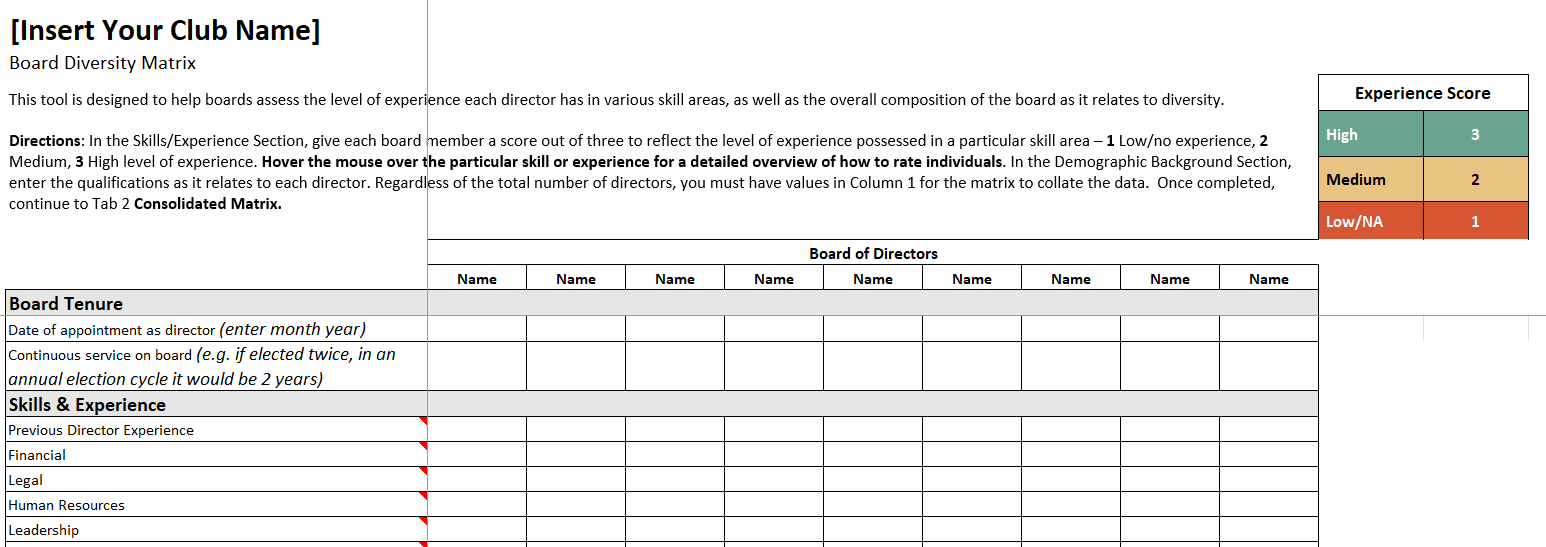
Without inferring any prejudices, a board with too many accountants or solicitors will tend towards group think (unconsciously), so having a broader mix of skills is important to create the more diverse perspectives required for truly robust board discussions and decisions. In an engineering association board, for example, unless the engineers have some diverse experience in areas other than engineering, it will be important to recruit external non-engineer directors, for the other skills required.
Importantly, existing and potential directors must understand the matrix is not a tool to select and remove people, simply a tool to identify the skills available to the board, now and into the future.
Selection
Selection processes vary from open nominations for any member of an organisation or association, through the use of a Selection Committee to review the applicants and decide who can stand for election, to the ability for boards to make appointments of directors to the board. Appointments can be made to either fill a casual vacancy (created by the departure of a director) or to bring a specific skill set to the board that is missing.
In the registered club setting, all members of a club are eligible to nominate for the board and then stand for election, when the election cycle occurs (this can be annually, biennially [every two years] or triennially [one third of the board elected every year, to a three year term]). The club can advertise those skills they would like any potential director to possess, to enhance the diversity and effectiveness of the board.
When a Selection Committee or an appointment process is in play, the aim is not to discriminate against an individual, rather to identify the best person for the Board, who can bring the skills or desirable attributes to the table, to again enhance the board’s operation. Key issues here include gender, ethnicity and age, where it can be of great benefit to aim for a balance of all three, that most closely resembles the organisation’s membership or community.
Tenure
Board Tenure varies enormously across organisations, industries and regions. For some NFP boards there are no limits on tenure so that unless a director resigns, dies in office or is removed from office (due to constitutional conditions), they can stay on the board indefinitely. During the decade commencing in 2010, there was a global push to limit tenure on boards to somewhere between eight and ten years (nine was common where the triennial election cycle prevailed, equating to three terms of three years). What eventuated was quite unexpected, in that corporate knowledge walked out the door when directors were (kind of) forced off the board for tenure reasons. In some ways this highlighted the ineffective succession planning being used (or not used in reality) so mistakes that had been made previously were repeated in some cases.
I am a fan of tenure in the prime sense of renewal and reinvigoration of boards. There is a good reason behind the limit of two four year terms for a United States President. It is taxing both physically and mentally and after eight years, is the President performing at peak? Similarly prolonged periods on a board can lead to a BAU Business as Usual approach, which may not be the best for the organisation. New directors, new ideas – tempered with the sensible transfer of corporate knowledge - can be the trigger for innovative growth and renewal of the organisation’s performance.
When I hear - If it ain’t broke, don’t fix it – I ask If it ain’t broke, how can we do it better? Sensible use of tenure, where you step off the board for a break, and can potentially re-join the board after a year or two, can also be a beneficial way to manage tenure. My bottom line on tenure though is – if a director continually contributes to the board, is always looking for how to improve the operations of the organisation and is still keen to be part of the innovation and growth – then stay on the board as long as legislation or the constitution allows.
Performance evaluation
Not many boards evaluate their performance, sadly. Whilst the directors ensure the employees are performance managed, with KPIs (key performance indicators) to achieve and salaries reviewed at least annually, the Board just poodles along without assessing their performance. This can be achieved in two ways – internal review or external review.
Internal reviews can be of benefit if well designed and implemented honestly and openly. Most NFP boards oversee smaller organisations, which may not have the capacity – personnel or expertise – to do an effective internal assessment. And their funds may limit what they can do in terms of engaging an external assessor.
External reviews are usually far more effective in identifying the level of performance of a board. They can be simple or highly granular (the AICD has an excellent tool Board Insights) and depending on your resources, either option can be a great starting point.

An effective performance review will identify where the Board can improve its effectiveness with guidance from the consulting body on how to address any areas considered areas that could do with some improvement. Annual reviews are ideal, but if you have never done one, now is a great time to start and arrange for a Board Performance Evaluation.
Any review should consider the modus operandi of the board – Does the board use an agenda, does the board offer professional development opportunities, do board meetings run for a reasonable amount of time (this varies pending frequency of meetings) and does the board engage with their organisation (physical visits to company venues and regular interaction with staff)?
Succession Planning
As already discussed, succession planning is critical for the long term success of any board, to provide quality governance and operational oversight of your organisation. Discussions around succession planning should be on the Board Agenda on a regular basis (depending on your meeting frequency). Club boards still tend to meet every month (12 times er year) so quarterly discussions are more than sufficient. If your board only meets four to six time per year, then perhaps it should be an agenda item at every meeting.
Succession planning discussion should centre around whose tenure may be finishing, who is planning to voluntarily retire or step off the board and when, and who may have been identified as a potential director. It is vitally important to have a pipeline of potential directors in the wings, being educated in the art of Board operations through a mix of Observership programs, membership of Board Sub-Committee(s) to learn the procedures of committee operation and holding information sessions on the roles and responsibilities of directors.
Many NSW Registered club constitutions now mandate the attendance of potential board candidates at a Board Nomination Information Session, when they learn the roles and responsibilities of club directors, including the legislated education they must complete in order to comply with the regulatory requirements of the club industry.
AICD provides excellent opportunities for directors and potential directors to study governance in their company Directors Course, considered the ultimate in Governance education in Australia for both NFP and For Profit Boards, as well as providing members with Directorship Opportunities, which provides an excellent avenue for organisations to utilise as part of their Succession Planning and Recruitment processes.
There is so much more that can be discussed in Board Composition and Effectiveness, including effective induction processes for new directors, the types of meetings (including the occasional In Camera session), remuneration and managing the Board management relationship, but this article has already covered a lot of ground.
For more information on, or to review the Board Composition and Effectiveness for your organisation, contact Ron Browne, Managing Consultant 0414 633 423 ron@extrapreneurservices.com.au.